Types of Specialized Investment Funds (SIF): Detailed Guide
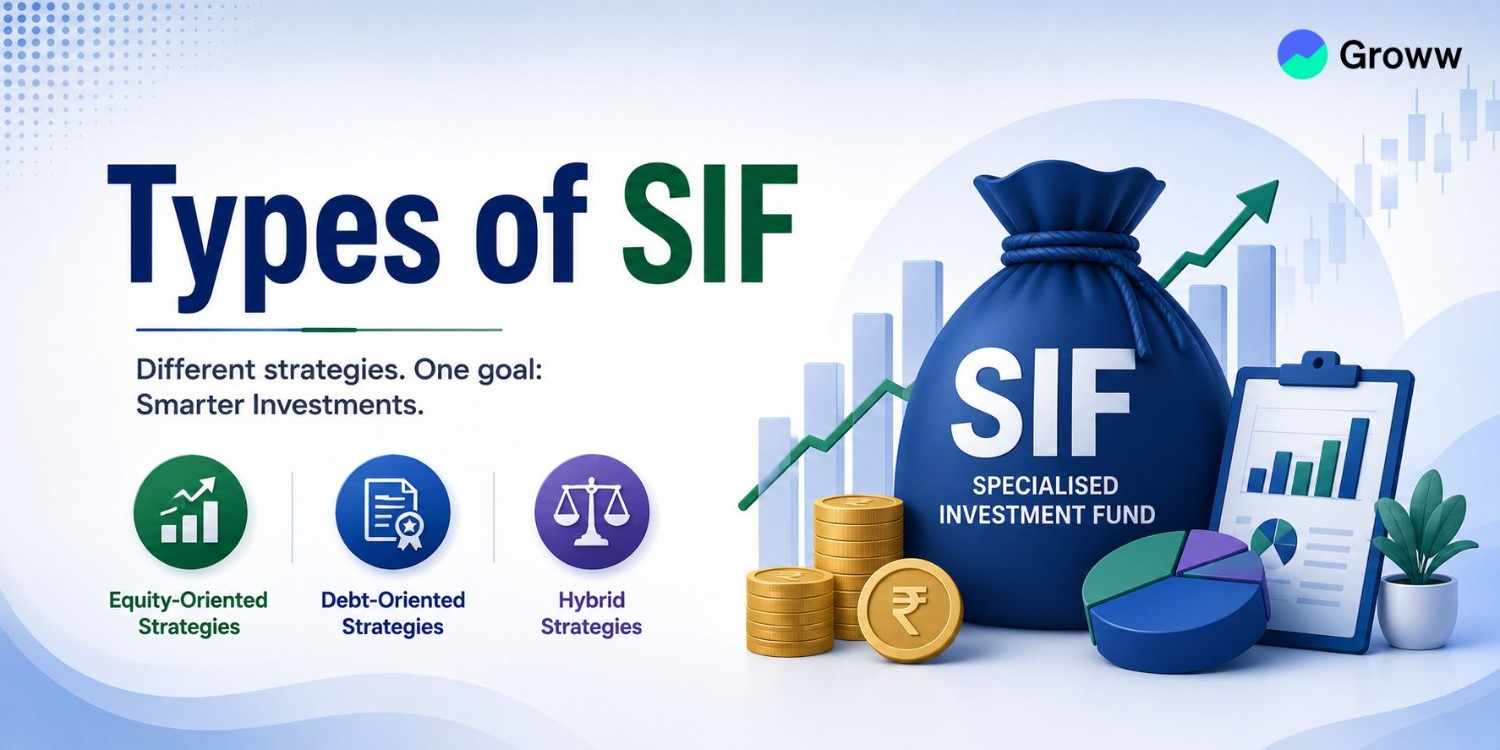


The main types of SIFs in India are equity-oriented SIFs, debt-oriented SIFs, and hybrid SIFs, which can be further classified by strategies such as long-short, ex-Top 100 long-short, sector rotation long-short, and active asset allocation long-short.
Specialised Investment Funds, or SIFs, are SEBI-regulated investment vehicles designed for sophisticated investors who want access to more flexible strategies than traditional mutual funds. Unlike regular mutual funds, SIFs can use derivatives, short positions, and dynamic allocation techniques within defined regulatory limits.
This blog explains the different types of SIFs in India, how they are classified by asset class and investment strategy, and which type may suit different investor profiles.
Key Takeaways:
- SIFs are a SEBI-regulated investment vehicle for HNIs, requiring a minimum investment of ?10 lakh
- SIFs can be classified by asset class (equity, debt, hybrid) and by investment strategy (long-short, ex-Top 100 long-short, active asset allocation, and sector rotation).
- Equity SIFs follow equity mutual fund taxation; debt SIFs are taxed as debt funds; hybrid SIFs depend on their equity allocation.
- SEBI permits SIFs to use derivatives, short selling, and leverage capabilities unavailable in traditional mutual funds.
- Different SIF types suit different investor profiles: equity long-short SIFs for aggressive growth seekers, debt SIFs for stability-focused HNIs, and hybrid SIFs for balanced risk appetites.
Over the years, the investment avenues available for high-net-worth individuals (HNIs) and ultra-HNIs were Portfolio Management Services (PMS) or Alternative Investment Funds (AIFs). ?50 lakh to ?1 crore minimum commitments.
But not all SIFs are alike. A debt long-short SIF is fundamentally different from an equity SIF or an active asset allocation SIF in risk profile, return expectations, investor suitability, and tax treatment.?
What is a Specialized Investment Fund?
A Specialized Investment Fund (SIF) is a new category of investment vehicle introduced by SEBI (Securities and Exchange Board of India) in a circular dated February 27, 2025. It is designed to give investors access to complex, flexible investment strategies, including long-short strategies, derivatives-based approaches, and dynamic asset allocation, within a regulated mutual fund structure.?
Key defining features of a SIF:
- Minimum investment: ?10 lakh per investor (across all SIF strategies of a fund house)
- Eligible investors: Resident individuals, NRIs, HUFs, institutions, provided they meet the minimum threshold
- Fund manager requirement: At least 10 years of experience and management of ?5,000 crore+ in AUM
- Short selling: Permitted within defined regulatory limits
- Structure: Can be open-ended, closed-ended, or interval-based
SIFs are regulated under SEBI's Mutual Fund Regulations. This means SIF investors benefit from the same custody, audit, and disclosure norms that apply to mutual funds, but with the strategic latitude closer to that of hedge funds or PMS.
How are SIFs classified?
Based on Asset Class
- Equity-Oriented SIFs
- Debt-Oriented SIFs
- Hybrid SIFs
Based on Investment Strategy: How the fund generates returns and manages risk
- Long-Short
- Ex Top 100 Long-Short?
- Sector Rotation Long-Short
- Active Asset Allocator Long-Short
Types of SIFs Based on Asset Class
Equity-Oriented SIFs
An equity SIF aims to generate long-term capital appreciation by investing in equities and equity-related instruments, while also short-selling through unhedged derivatives to hedge and generate alpha.?
An Equity SIF can simultaneously hold long positions worth, say, 90–100% of its assets while running short positions of up to 25%, resulting in a net long exposure of roughly 65–75%. The short positions are primarily implemented through stock futures, index futures, or options strategies.?
Sub-Types Within Equity SIFs:
-
Equity Long-Short
This is the broadest and most commonly launched equity SIF strategy. It offers flexibility across market capitalisations and allows the fund manager to invest without being constrained by any specific market-cap segment or investment style. In short, there’s no bias towards any market cap size or sector.?
The requirements as per SEBI's circular are:
- Minimum investment in equity and equity-related instruments: 80%
- Maximum unhedged short exposure through derivative positions: 25% of net assets
- Structure: Open-ended or interval
- Minimum redemption frequency: Daily (or any lesser frequency as per AMC guidelines)
-
Equity Ex-Top 100 Long-Short
Equity Ex-Top 100 Long-Short is specifically designed for investors seeking alpha in the mid-cap and small-cap space, where pricing inefficiencies tend to be larger. The parameters are:
- Minimum investment in equity and equity-related instruments of stocks outside the top 100 by market capitalisation is 65%?
- Maximum unhedged short exposure: 25% of net assets
- Structure: Open-ended or interval
- Minimum redemption frequency: Daily (or any lesser frequency as per AMC guidelines)
-
Sector Rotation Long-Short
This strategy concentrates investments in equity and equity-related instruments across up to 4 high-potential sectors, while employing limited short exposure through derivatives to capitalise on sector-specific downturns. The defining parameters are:
- Minimum investment in equity and equity-related instruments, across a maximum of four sectors: 80%
- Maximum unhedged short exposure: 25%, with the important clarification from SEBI that this short exposure applies at the sector level, covering all stocks within a shorted sector held in the portfolio
- Structure: Open-ended or interval
- Minimum redemption frequency: Daily (or any lesser frequency as per AMC guidelines)
Debt-Oriented SIFs
Debt-oriented SIFs invest primarily in fixed-income instruments. The distinguishing feature is the ability to take short positions in debt markets via exchange-traded debt derivatives.?
“As of June 2026, there are no pure debt-oriented SIFs in India.”
Sub-Types Within Debt SIFs:
-
Debt Long-Short
This strategy can go long on bonds across various durations and simultaneously take short exposure when the fund manager expects yields to rise or specific bond prices to fall. The key parameters are:
- Investment across debt instruments of various durations
- Maximum unhedged short exposure through exchange-traded debt derivative instruments: 25% of net assets
- Structure: Interval
- Minimum redemption frequency: Once a week or any lesser frequency
The restriction to exchange-traded debt derivatives (as opposed to over-the-counter instruments) is a risk control measure; it ensures price transparency and reduces counterparty risk.
-
Sectoral Debt Long-Short
This strategy introduces a concentration discipline; it must invest across at least two debt sectors and cannot concentrate more than 75% in a single sector.
- Investment in debt instruments of at least two sectors
- Maximum allocation to a single sector: 75%
- Maximum unhedged short exposure: 25%
- Structure: Interval
- Minimum redemption frequency: Once a week or any lesser frequency
Hybrid SIFs
Hybrid SIF strategies invest across multiple asset classes simultaneously: equity, debt, and potentially derivatives on both; REITs; InvITs; and commodity derivatives. SEBI has defined two strategies in this category, both of which are more complex in structure than the equity or debt-only strategies.
Sub-Types Within Hybrid SIFs:
-
Active Asset Allocator Long-Short
Active asset allocation is the most flexible SIF strategy in terms of asset class scope. The fund manager can dynamically shift the portfolio across:
- Equity and equity-related instruments
- Debt instruments
- Equity derivatives
- Foreign Securities
- Debt derivatives
- REITs and InvITs
- Commodity derivatives
There is no fixed minimum allocation to any single asset class; the entire portfolio can dynamically shift based on prevailing market conditions, economic trends, and risk-return opportunities. The key constraint is the short exposure limit:
- Maximum unhedged short exposure through derivative positions in equity and debt combined: 25% of net assets
- Structure: Interval
- Minimum redemption frequency: Two times a week or any lesser frequency
-
Hybrid Long-Short
Hybrid Long-Short mandates a meaningful allocation to both equity and debt at all times, unlike the active asset allocator, which has no fixed floors. The parameters are:
- Minimum allocation to equity: 25%
- Minimum allocation to debt: 25%
- Maximum unhedged short exposure: 25%
- Structure: Interval only?
- Minimum redemption frequency: Two times a week or any lesser
Open-Ended, Close-Ended, and Interval SIFs
Beyond asset class and strategy, SIFs are also classified by their structural liquidity terms:
|
Structure? |
Liquidity |
|
Open-Ended |
Daily redemption available |
|
Close-Ended |
Fixed maturity (typically 3–5 years) |
|
Interval |
Specific windows (quarterly/annual) |
Risks Across Different Types of SIFs
The risk associated with a Specialized Investment Fund (SIF) depends primarily on its underlying investment strategy, asset allocation, use of derivatives, leverage, concentration limits, and liquidity profile. As a result, different SIF strategies may carry significantly different levels of risk.
To help investors assess and compare risks across investment strategies, SEBI has introduced a Risk Band framework for SIFs. Under this framework, each SIF strategy is assigned “Risk Band Levels” on a scale of 1 to 5, where 1 is the lowest and 5 the highest.
Taxation of Different Types of SIFs
SIF taxation follows the underlying asset class composition, similar to mutual fund taxation rules.?
Equity-Oriented SIFs
- Short-Term Capital Gains (STCG): held < 1 year: 20%
- Long-Term Capital Gains (LTCG): held ≥ 1 year: 12.5% (above ?1.25 lakh annual exemption)
- Dividend income: Taxed as per the investor's income tax slab?
Debt-Oriented SIFs
All gains (regardless of holding period): Taxed as per investor's income tax slab rate
No indexation benefit (as per Finance Act 2023 amendments)
Hybrid SIFs
- Short-Term Capital Gains (STCG): held < 1 year: Taxed as per investor's income tax slab
- Long-Term Capital Gains (LTCG): held ≥ 1 year: 12.5%?